Tuesday, November 1, 2016

Reading Notes: Nine Ideal Indian Women, Part B


Well, it turns out that this was not the wife of Siva (Shiva) that I was wanting to write my storybook about.  This was about Sati, who was mortal born and prayed to Shiva from childhood to become his wife.  She lived in poverty alongside him and died due to her father’s pig-headedness.  Or goat-headedness as the case may be. 

Clearly I need to do a little more research into the relationship between Shiva and Kali, since I assumed consort meant wife, which does not appear to be the case.  I know I’ve read about Kali and Shiva earlier in the semester, but I’ll have to find the particular reading now.  Wish me luck!

Bibliography: Nine Ideal Indian Women by Sunity Devee (1919), Internet Archive.

Image Info: Sati and Shiva. Source: Wikimedia Commons 

Monday, October 31, 2016

Reading Notes: Nine Ideal Indian Women, Part A

Week 11 already! I chose to read Sunity Devee’s Nine Ideal Indian Women this week, trying to get an idea of how to wrap up my storybook this semester.  The second half of this reading talks about Sati, the first wife of Shiva, which I’m hoping will help me write my last story.  However, I decided to go ahead and read the entire unit, which starts with Savitri and Damayanti. 


I really enjoyed the stories of these two Indian women.  They are women of strength and keen intelligence, which is often lacking in modern literature, at least without coming off as some sort of cliché or appeasement.  I really like that the stories focus on them and their power over their fates.  If I were still writing a storybook about Charlotte Grimm, I would probably incorporate one of these, but they don’t quite work with John’s storyline.

I’m looking forward to the rest of the readings this week so I can hopefully find something to use in my storybook!

Bibliography: Nine Ideal Indian Womeno by Sunity Devee (1919), Internet Archive.

Image Info: Savitri. Source: Wikimedia Commons

Wednesday, October 26, 2016

Story Planning: The Final Two

I came up with ideas for my last two stories in my storybook while doing my readings this week. My first idea involves inserting John into the story of Ganesh. Obviously, there are countless renditions of who Ganesh is exactly and how he came to be.  According to the story that I read this week, he is the son of Shiva and is considered the remover of obstacles.  In the story, Ganesh loses his head due to a curse placed on a man, who destroyed anything that he gazed upon.  As a result, Ganesh’s head was chopped off and he died.  Obviously.  However, Shiva told his messengers to go forth and bring back the head of the first living creature they came across, which was an elephant.  I thought it would be great to somehow get John in on this.  I think it would be fun to have Shiva send him out with the other messengers in search of a head to place on Ganesh’s shoulders, and John decides that an elephant head will do fine.  They like elephants in India, right? (John’s logic, not mine, I promise).  Somewhere along here, I’m going to find a logical place for Charlotte to show up, probably towards the end.


Okay, and my second idea for the very last story in my storybook is use the story of Parvati/Kali, the wife of Shiva.  My idea is for her and John to have their awesome reunion, but then have Parvati go and do battle with Raktabija.  I’ve still got time to figure this particular story out, but I want to somehow have Kali go do battle with Raktabija and then use Charlotte in the battle as well while John and Shiva sit on the sidelines and watch, talking about how scary their wives are.  It’ll take some more research and planning, but since it’s my last story, I’ve got plenty of time for that later. 

Bibliography: Tales of Ancient India by Edmund Cox (1887), Hathi Trust. 
Image Info: Kali. Source: Wikipedia. 

Tuesday, October 25, 2016

Reading Notes: Cox's Tales of Ancient India, Section B

I didn’t exactly love the second half of this week’s reading.  It was rather slow and a little dull, although the content itself was interesting.  This half of Cox’s Tales of Ancient India discussed the gods and their beginnings, more or less.  I was relatively unamused with most of it, although I did think of an interesting way to work one of the gods into my storybook.  I kind of wanted to work Kali into my storybook and have her and Charlotte work together in some way.  I think it could be very entertaining to see those two together with John and Shiva watching from the sidelines.  Maybe I can have Charlotte aid Kali in her battle, although in this reading she goes by the name Uma.


I think I might also work John into the story of how Ganesh ends up with the head of an elephant.  It seems like the type of solution that he would come up with, considering he probably wouldn’t believe that just replacing the head would bring a being back to life, so who cares what head they bring back!

Bibliography: Tales of Ancient India by Edmund Cox (1887), Hathi Trust

Image Info: Ganesh. Source: Wikipedia.

Monday, October 24, 2016

Reading Notes: Cox's Tales of Ancient India, Section A

This week, I chose to read another version of the story of Krishna, the reincarnation of Vishnu that we met in the Mahabharata. 


I thought it might be fun to write part of this story from the eyes of one of the villagers.  Constant struggle and destruction is brought to their village because of the young Krishna, which results in the deaths of some of their children and the destruction of their homes.  Who wouldn’t be frustrated and want to banish the family that hosts this child?


I’m hoping to try to work this week’s reading into my storybook.  I’m trying to think of a way to use Krishna, but he seems so much stronger and independent than my other characters so it may be a little more difficult to fit John into the story.  And possibly Charlotte.   I could also write about how Krishna and Rukmini became wed. 

Bibliography: Tales of Ancient India by Edmund Cox (1887), Hathi Trust. 

Image Info: Krishna eating butter. Source: Wikimedia Commons.

Wednesday, October 19, 2016

Storytelling: Tempted by Darkness


I really wish I wasn’t married to this buffoon. Brihaspati is nice and all, but he’s a little old and incredibly boring.  All he ever does is come up with lessons to teach the gods.  I mean, it IS his job, but come on! Can’t we go on an adventure or vacation every once and a while?! All the other celestial beings do…

This was my running mental tirade almost every single day until a Dánava named Shoma waltzed into my life.  I honestly think it was the best day of my life, even though I’m sure my husband didn’t exactly have the same view on the matter.  You see, Shoma was a demon.  A handsome, charming, chivalrous, and exciting demon, but a demon nonetheless. The gods had been at war with the demons for as long as any of them can remember, although they don’t exactly know why or how the war started.  The reasons have been lost to memory. 

I’m sure my husband and the other gods and celestial beings believe that I was enticed away to the kingdom of darkness, but that wasn’t exactly what happened.  Shoma approached me one day while I was sitting in one of the many groves of trees that are found around the heavens.  It was a beautiful grove, with big, shady trees to block the heat of the sun, brightly colored flowers perfuming the cool air, and a broad, cushioned bench to recline on.  Usually, no one comes near the grove when I’m in there, or anywhere else for that reason.  I have a bit of a bitchy resting face, which is part of the problem. The rest comes from the fact that I’m not like everyone else up there, content to sit around every day and just enjoy the life that we have in the heavens.  It’s boring!

Shoma was different.  He came up to me and started to talk, asking why I was alone and why I seemed so sad.  Honestly, he was the first person to really show an interest in me.  I was a little starved for attention up here, since my husband was always teaching and everyone else avoided me.  It was nice to just have a conversation with someone.  Of course, I knew he was a demon, but I didn’t really care.  You see, no one knew it, but I had the ability to see people’s true nature.  Yes, Shoma was a demon on a mission to sway me, but he became truly interested in me as a person while we talked.  It was amazing!

To be completely honest, when he asked me to go with him to the darkness (which is really just the world outside of the heavens) I didn’t even hesitate to say yes.  I was just so excited to get away from the people who shunned me and to meet new people and have some adventures!

Since that day, I’ve been living with Shoma in the darkness, fighting the people I’d once lived among and generally just having fun! It was fun being with the demons. They didn’t really care what others thought and were always willing to try some new adventure.  From their viewpoint, the gods were selfish, keeping the heavens and immortality and all the good of the world for themselves.  They wouldn’t even give the demons the opportunity to work their way into the heavens.  The demons fought for every bit of clean water, hot food, and the smallest bits of happiness that they could find.
 
I helped them with a lot of that, showing them places to find clean water outside of the heavens.  I honestly think that I can help them make a life worth living outside of heaven, provided the gods let them.  Every time I make a little headway, the gods ruin everything that I’ve built up.  Clean water system, blown apart.  Warming ovens, brought to ruins. Hunting equipment, stolen.  Good hunting grounds, all the animals disappear.  I’m hoping that Shoma and I can work out some sort of peace treaty between the gods and demons.  It’s the only way that everyone will actually be able to live in peace, once and for all.


Author’s Note:
I decided to write a part of Dutt’s Tales of India that was only alluded to with a single sentence.  The sentence is: “The wicked Danava tempted her to the path of sin; she fell; and she was enticed away to the kingdom of darkness” (p.8).  ‘She’ is the wife of Brihaspati, the Perceptor or teacher to the gods.  It is really the only time that she is mentioned and I was very curious as to how and why she would be tempted to ‘the darkside.’  Persephone and Hades were the first thing that came to mind and I kind of derived my story from that idea.  While she doesn’t exactly become the Queen of the Underworld, she still has a significant effect on it.  I also thought that it would be interesting to see the life on the other side of the curtain.  We always get to read about how the demons are evil and the gods are in a constant war against them because they are so evil, but what do the demons think? Anyway, that’s where my idea came from. It’s not much to go on since I derived it from one sentence in the entire story!


Bibliography: Gleanings from Indian Classics, Volume 1: Tales of India by Manmatha Nath Dutt (1893), Internet Archive. 

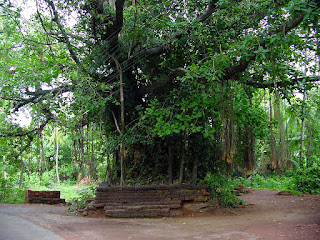
Image Info: Brihaspati. Source: Wikimedia Commons; Tree Grove. Source: Wikipedia. 

Tuesday, October 18, 2016

Reading Notes: Dutt's Tales of India, Section A

I chose to read Manmatha Nath Dutt’s Tales of India for my week 9 readings.  It tells the story of Hindu legends and religious beliefs, more or less, and makes many connections between the Hindu story and the story of Christ.  I always think it is interesting how similar many religions are to one another, if you boil them down to a basic story.  Both Hindu and Christianity tell the story of god’s son ridding the world of evil.  And both stories tell of the battle between heaven and hell, in one way or another. 

There were several parts of this reading that I could use for a story.  One idea came from a simple sentence: “The wicked Danava tempted her to the path of sin; she fell; and she was enticed away to the kingdom of darkness” (p.8). 

My other idea was to expand on the story of Sati/Kali and her battle with the demon kings.  I’ve heard of Kali for years, but it was really interesting to see her story told in a more original format.

Another thought was thought was to try to expand on the description of Sati’s beauty in some way.  It simply says that she was too beautiful to describe, but they didn’t even try!

Yet another idea was to write about the “thousand and one means to kill the young prince” Prahlada. I think it would be fun (and funny) to write increasingly unbelievable attempts to kill Prahlada.  It would be a fun mental and creative challenge, I think.


I have also considered using the tale of Shiva and Sita as part of my storybook.  I think it would be interesting to include a female hero in the story.  I could write about her attempts to defeat the demon kings, or something along those lines. 


Bibliography: Gleanings from Indian Classics, Volume 1: Tales of India by Manmatha Nath Dutt (1893), Internet Archive. 

Image Info: Kali. Source: Wikipedia.